Athletic Socks
Print Socks
- Low Minimums
- Lowest Industry Pricing
- Free Shipping $250+
- USA Sock Designers

You’re probably reading this with a half-formed giveaway idea already bouncing around your head.
Maybe you’ve got a trade show coming up, an employee appreciation push on the calendar, a client mailer that needs something more interesting than another postcard, or a last-minute event where someone just said, “Can we order some swag?” That’s usually how giveaways for companies begin. Fast. Slightly chaotic. One spreadsheet open, three tabs of promo products, and one nagging question nobody wants to say out loud: is any of this really going to work?
It can. It also regularly doesn’t.
The difference usually isn’t the logo. It’s not even the budget. It’s whether the company treats the giveaway like a marketing program or like a junk order with branding slapped on top. The smartest teams think about purpose, logistics, and measurement before they pick the item. They choose something people will keep. Then they make sure they can prove the effort did more than decorate a conference tote bag.
Open almost any office drawer and you’ll find the same little graveyard. A cracked stress ball. Three dried-out pens. A thumb drive from a company nobody remembers. A keychain that looked cheap on day one and worse by day three.

That’s the ugly truth about a lot of giveaways for companies. They aren’t bad because giveaways don’t work. They’re bad because somebody ordered the most forgettable item possible, picked the lowest acceptable quality, and hoped a logo would do the heavy lifting.
It won’t.
A branded item only works when the recipient wants it, uses it, or at least notices it twice. The upside is much bigger than often recognized. A substantial 85% of people report having a more favorable view of a company after receiving a branded product, and 83% of consumers are more likely to do business with a brand after receiving a promotional item, according to these promotional products statistics.
Recipients make fast judgments. If the item feels flimsy, generic, or pointless, they don’t separate that from your brand. They connect the dots immediately. If this is what you hand out, maybe this is how you handle details everywhere else.
That’s why the “more items for less money” mindset usually backfires. Volume feels efficient on a purchase order. It feels wasteful in practice.
Bad swag doesn’t just get ignored. It quietly tells people your brand has low standards.
A useful giveaway keeps doing its job when your team is gone. It can live on a desk, in a gym bag, in a travel pouch, or in a dresser drawer that gets opened every week. That repeated exposure matters more than the five seconds when someone first grabs it off a booth table.
The strongest company giveaways usually share a few traits:
If you want a deeper look at why wearable promo can outperform forgettable trinkets, this piece on using socks to make an impact in marketing gets the point across nicely.
Most giveaway failures aren’t creative failures. They’re judgment failures. Teams pick what’s easy to order instead of what’s worth receiving.
Before you choose an item, choose the job that item needs to do.
That sounds obvious, yet plenty of teams skip it. They go shopping before they decide whether the giveaway is meant to drive booth conversations, reward employees, generate leads, thank donors, or nudge prospects toward a follow-up meeting. Then they wonder why the result feels mushy.
A single giveaway can support more than one outcome, but it still needs a primary purpose. If you don’t decide that upfront, the campaign gets fuzzy and the spend gets sloppy.
Use this quick planning lens:
| Goal | What the giveaway should do | What to avoid |
|---|---|---|
| Brand awareness | Be memorable and easy to keep | Disposable novelty items |
| Lead generation | Create a reason to scan, sign up, or claim | Handing everything out with no capture step |
| Employee morale | Feel personal and worth using | Generic leftovers from event inventory |
| Client appreciation | Reinforce quality and thoughtfulness | Anything that looks mass-produced |
| Event traffic | Start conversations fast | Items people can grab without engagement |
Many teams get themselves in trouble by wanting a product that does everything, for everyone, at the lowest possible cost. That usually produces an item nobody cares about enough to remember.
The item cost is only one line on the sheet. The actual program cost is wider than most first drafts account for.
According to this giveaway business cost breakdown, critical cost components include prize acquisition or production cost, shipping and logistics, paid promotion budget, and software or platform fees. A pre-campaign budget lockdown is essential for success.
That budget lockdown matters because giveaways get expensive in sneaky ways. Freight changes. Address lists need cleanup. Packaging gets upgraded late. Someone adds paid social after the product is already approved. Suddenly the “cheap” campaign isn’t cheap at all.
Planning rule: If you only priced the item, you haven’t priced the giveaway.
A practical giveaway budget usually needs these buckets:
Once the goal and budget are clear, make a few decisions before anyone falls in love with a product sample:
Those answers make product selection much easier. They also keep your giveaway from turning into one more branded expense nobody can defend later.
Some promo items are born to be ignored.
They’re awkward, flimsy, or so generic that the recipient already has three versions at home. You can spot them instantly. They sit in fishbowls at booths, disappear into tote bags, and never make it into real use.
The better question isn’t “What can we put our logo on?” It’s “What would someone choose to keep even if our logo weren’t on it?”

A good giveaway doesn’t need to be flashy. It needs to be useful, distinctive, and appropriate for the audience. If it also happens to make people smile, even better.
Here’s the filter I’d use before approving any item:
Yes, socks.
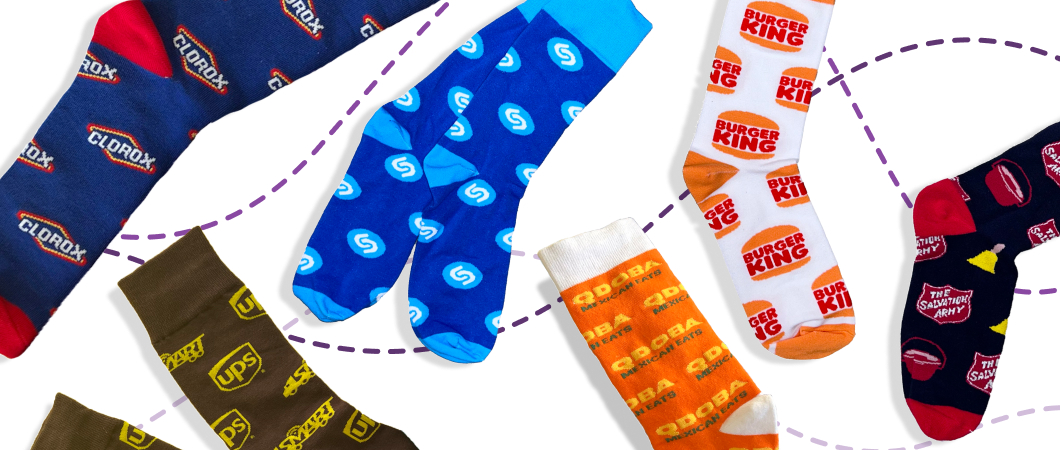
Custom socks hit a weirdly effective middle ground that a lot of giveaway categories miss. They’re practical, wearable, easy to size in broad strokes, and much more fun to design than another branded office supply. They also don’t feel like filler. If the design is good, recipients treat them like apparel, not like swag.
That changes the emotional math. People don’t think, “I got a promo item.” They think, “I’d wear these.”
Wearable giveaways work differently because they leave the event and enter somebody’s routine.
Socks also solve a branding problem that many promotional products create. They give you room for personality without requiring a giant logo splash. A color palette, pattern, mascot, campaign line, or subtle mark can do the work without making the product look like a walking ad.
For trade shows, team merchandise, donor gifts, employee kits, and event drops, that matters a lot. If the item looks cool enough to wear on purpose, your brand has a longer runway.
This is the part most giveaway advice skips. They’ll tell you to pick something high quality and on-brand, then glide right past the fact that many teams are buying under terrible timelines.
A campaign gets approved late. A headcount changes. A keynote gets added. Merchandise arrives damaged. Someone suddenly needs branded gear for a pop-up, tournament, or recruiting event. In those moments, the item itself matters less than whether your vendor can deliver.
That’s why this gap matters: many promotional product resources ignore the operational reality that companies need fast turnarounds and low minimums for time-sensitive campaigns.
For buyers, that creates a simple decision test:
| If your reality is… | You need… |
|---|---|
| Last-minute event planning | Fast mockups and short production windows |
| Small pilot campaign | Low minimum order quantities |
| Multiple audience segments | Flexible design options |
| Branded apparel without hoodie-level cost | A wearable item with lighter logistical overhead |
One factual example in this category is our promotional giveaway ideas page, which reflects a setup with 12-pair minimums, 48-business-hour digital mockups, and options for woven or printed designs. Those kinds of specs matter when you’re not ordering six months ahead like a catalog fantasy.
Usually works
Usually doesn’t
Socks aren’t magic. They’re just one of the few categories that score well on usefulness, personality, portability, and operational sanity at the same time. That’s a pretty rare combo in giveaways for companies.
Choosing the item is only half the job. Execution is where decent ideas either become memorable or turn into a rushed pile of branded regret.
The handoff from concept to recipient needs more discipline than teams typically expect. Design, packaging, timing, shipping, and event distribution all shape how the giveaway is perceived.

Most ugly swag has the same disease. The company tries to fit every brand element onto one poor item, then acts surprised when it looks like compliance made it.
Good giveaway design starts with restraint. Pick the one or two visual cues that matter most. Let the item breathe. If the product is wearable, that matters even more, because recipients have actual taste and dignity.
A few practical design rules:
If you’re working on branded apparel, this guide to designing your own socks is a useful reference for translating logos and artwork into something wearable.
The best distribution method depends on the campaign, not your habits.
For trade shows, you might hand items out after a demo or badge scan. For remote teams, direct shipping usually makes more sense. For client campaigns, a claim-based flow can reduce waste because you only send to people who raise a hand.
Here’s the practical comparison:
The distribution method should support the campaign goal. If it doesn’t, you’re just moving inventory around.
A short product walkthrough can also help internal teams align on what polished branded merchandise looks like in practice:
Fulfillment is where enthusiasm goes to die if nobody owns it properly. Deadlines get missed. Recipient lists arrive messy. Event staff forget the distribution script. Winners don’t understand the claim process. Then the giveaway gets blamed for problems that were really operational.
Use a simple execution checklist before launch:
A smart giveaway doesn’t just look good in a mockup. It arrives on time, reaches the right people, and supports a conversation or action you care about.
This is the part buyers, finance teams, and skeptical executives care about most. Fair enough.
A surprising amount of giveaway advice stops at item selection, as if the only important question is whether people like mugs, socks, bottles, or tech gadgets. That leaves a huge gap for anyone who has to defend spend after the event. If you can’t measure the program, it’s just branded optimism.

A giveaway should be tracked like a funnel, not admired like a craft project.
According to this corporate gifting ROI framework, a structured giveaway measurement model follows a logical flow: Inputs (budget) → Activities (invites) → Outputs (redemption %) → Outcomes (meetings, opportunities) → Impact (revenue, ROI). The ROI formula is (Incremental Profit − Total Program Cost) ÷ Total Program Cost.
That structure is useful because it forces discipline. Instead of saying, “People seemed to like them,” you can say what happened at each stage of the program.
You don’t need a giant analytics stack to make a giveaway measurable. You need a few clear checkpoints and a way to connect them.
A practical scorecard can include:
| Stage | What to measure | Why it matters |
|---|---|---|
| Inputs | Budget, item choice, audience list | Shows what you invested |
| Activities | Invites sent, booth interactions, claim links shared | Confirms execution happened |
| Outputs | Redemptions, delivery success, design views, form fills | Captures immediate response |
| Outcomes | Meetings booked, qualified leads, repeat orders, follow-up replies | Ties activity to business movement |
| Impact | Revenue, retention, ROI | Proves the program’s business value |
If the giveaway is event-based, create one campaign code, one landing page, or one redemption path tied to that event. If it’s direct mail, use a specific claim flow. If it’s social, monitor tagged posts, photo sharing, and engagement around the campaign creative.
Measurement tip: Track one primary business outcome and a few supporting indicators. Too many metrics turns clean reporting into mush.
Teams often stop at shallow metrics. Booth traffic was good. People smiled. Boxes were emptied. Nice, but none of that tells you whether the campaign deserved another budget line next quarter.
A stronger setup connects the giveaway to a next step:
If trade shows are part of your mix, this article on maximizing your trade show ROI is relevant because it frames giveaways as one part of a larger event funnel, not a side activity.
After the campaign, hold a real review. Not a vague “seemed successful” chat while everyone’s already thinking about the next event.
Ask:
That final question is useful because it forces honesty. An item can be likable and still be wrong for the campaign. It can also be plain-looking and wildly effective. The point is not to crown a favorite swag object. The point is to build a repeatable, measurable giveaway system.
Most companies don’t need more swag. They need better judgment.
The gap between a forgettable giveaway and a productive one usually comes down to a few unglamorous decisions. Set a clear goal. Build a real budget. Choose an item people will use. Make sure your vendor can handle the timeline you have, not the fantasy timeline you wish you had. Then track the result like it belongs in your marketing program, because it does.
That discipline matters because the upside is real. The average ROI from promotional giveaways is 500% or more, and some sources report brands earning $6.41 for every $1 invested, as noted in these giveaway statistics for 2025. That doesn’t mean every branded trinket is suddenly a genius investment. It means well-executed giveaways for companies can be one of the most cost-effective tools in the mix.
You don’t need to reinvent the category. You need to stop doing the lazy version of it.
That means saying no to items that feel cheap, generic, or operationally painful. It means picking products with actual staying power. It means treating turnaround time and minimums as strategic criteria, not procurement footnotes. And it means finally getting serious about proof, so next year’s budget conversation starts with results instead of shrugging.
If you’re buying a giveaway because “we always need something for the table,” you’re already losing.
Buy because the item supports a real outcome. Buy because the audience will keep it. Buy because your team knows what success looks like before the order goes in. If that item happens to be a wearable with personality, strong utility, and easier logistics than bulkier promo gear, you’re probably on the right track.
If you want a giveaway people will wear instead of stash in a sad desk drawer, Custom Sock Shop makes custom socks in the USA with low minimums, fast mockups, and options for events, teams, employee kits, and branded campaigns. It’s a practical next step for companies that want swag with a little more shelf life and a lot less landfill energy.