Knowing how to price your custom socks comes down to a simple, yet delicate, balance. You have to cover your costs, see what your competitors are up to, and make sure the final price tag feels right for your brand. It’s one part hard math, one part market intuition, and the goal is always to find that sweet spot where you’re profitable and people are excited to buy.
Building Your Foundational Pricing Strategy
Pricing your socks is so much more than just slapping a number on them that sounds good. Seriously, it’s one of the most powerful tools you have. The price you set instantly tells customers what your brand is all about—are you a budget-friendly find or a premium, must-have item? Get it right, and you attract your ideal customer and build a sustainable business.
Think of it like this: your total product cost creates your pricing floor. That’s the absolute minimum you can charge without losing money on every single sale. Ouch. On the flip side, what the market will bear—based on demand and what competitors are charging—sets your pricing ceiling. The magic number, your optimal price, lives somewhere in that space between the floor and the ceiling.
Before you start crunching numbers, it helps to understand the three classic approaches to pricing. Most strategies are a blend of these, but knowing the core concepts gives you a solid framework for making decisions.
Core Pricing Strategy Overview
Strategy Type
Primary Focus
Best For
Cost-Plus Pricing
Your internal costs. You calculate your total costs and add a fixed markup.
Simplicity and ensuring a consistent profit margin on every sale.
Competition-Based Pricing
What your competitors are charging for similar products.
Positioning your brand directly against others in a crowded market.
Value-Based Pricing
The customer’s perceived value of your product.
Premium or highly unique products where quality and branding justify a higher price.
Each of these strategies has its place, and the best one for you might even change over time as your brand grows and the market evolves.
The Core Elements of Pricing
A smart pricing strategy isn’t just pulled out of thin air. It’s built by carefully considering a few key ingredients that all work together. Nail these, and you’ll have a framework that makes every other decision a whole lot easier.
Your final price should always account for:
Costs: This isn’t just what you paid the manufacturer. It’s everything—shipping, packaging, marketing dollars, transaction fees, and even your own time.
Customers: Who are you selling to? What do they value? A premium sock made with merino wool can command a much higher price than a simple cotton crew sock, but only if you’re targeting the right audience.
Competitors: You have to know what other sock brands are charging. This helps you figure out where you fit in. You can price higher, lower, or right in the middle, but you need a good reason for that choice.
Brand Identity: Your price is a huge part of your brand’s story. A high price signals luxury and quality, while a low price signals accessibility. To make sure your pricing and messaging are on the same page, you have to build a strong brand identity.
A classic mistake is getting so bogged down in cost calculations that you forget about the powerful psychology of pricing. That price ending in “.99” isn’t just a gimmick. Decades of studies show that our brains perceive $19.99 as significantly cheaper than $20.00, and that small difference can genuinely influence whether someone decides to buy.
Ultimately, your goal is to land on a price that moves you toward your business goals. Whether you want to be the go-to budget option or the exclusive, high-end leader, your pricing has to be intentional. Get this foundation right, and you’ll ensure every sale you make is a step in the right direction.
Calculating Your True Product Costs
To really nail your retail pricing, you have to become an expert on your expenses. Trust me, just looking at the manufacturer’s invoice is a classic rookie mistake that leaves serious money on the table.
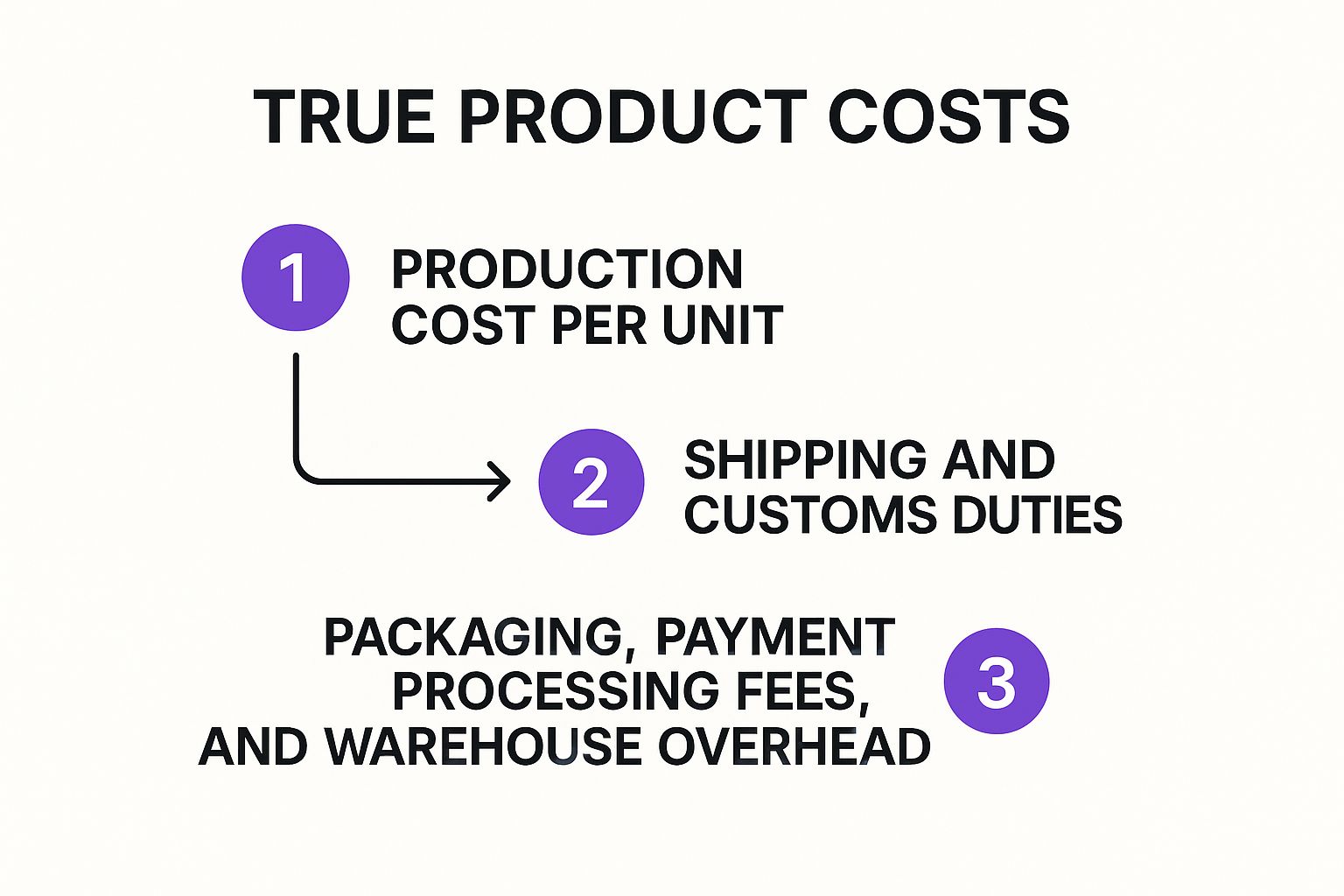
The true cost of your custom socks goes way beyond what you pay per pair. It includes every single expense required to get that item from the factory floor into your customer’s hands.
This total figure is what we in the business call the landed cost. It’s the most critical number in your entire pricing formula because it sets your profitability floor. If you sell below this number, you’re actively losing money on every single order. No business can survive that for long.
As you can see, the cost builds up layer by layer. Each step adds a necessary expense that absolutely has to be baked into your final retail price.
Beyond the Factory Invoice
Your first cost is the most straightforward one: the Cost of Goods Sold (COGS). This is simply what your supplier charges you for each pair of socks. If you’re still looking for a partner, our guide on how to find wholesale suppliers can help you lock down someone reliable and transparent.
But the journey doesn’t end there. Not even close. Next, you have to factor in all the logistical costs that come with getting the product to you. These often include:
Shipping & Freight: The cost to get your bulk order from the manufacturer to your warehouse or fulfillment center.
Customs & Duties: Taxes and fees for importing goods. These can vary wildly depending on the product and country of origin, sometimes adding a huge percentage to your base cost.
Inbound Receiving: The labor costs for unloading the shipment, inspecting the socks, and getting them stocked on your shelves.
These “in-transit” costs are so easy to overlook, but they can easily tack on another 15-20% (or more!) to your initial COGS. Ignoring them is a direct punch to your profit margin.
The Hidden Costs of Selling
Once the socks are safely in your warehouse, a whole new set of costs pop up. These are the expenses tied directly to selling and fulfilling each order. Think of them as the “last mile” costs that complete your landed cost calculation.
You’ll want to account for things like:
Packaging: Mailers, boxes, tissue paper, and those little thank-you cards.
Payment Processing Fees: Platforms like Shopify Payments or PayPal will typically take around 2.9% + $0.30 from every transaction.
Warehouse Overhead: A small piece of your warehouse rent, utilities, and software costs, allocated per unit.
Picking & Packing Labor: The wages you pay for the time it takes an employee to grab an order and get it ready for shipment.
Let’s put it all together. Imagine you run a small online sock boutique. You calculate that after adding up all these sneaky fees, your true landed cost for a pair of socks is $4.75, not the $3.00 you paid the manufacturer. Armed with that accurate number, you can now set a retail price of $15.00 knowing you have a healthy margin to cover marketing, salaries, and other business overhead.
That’s how you make sure every single sale is genuinely profitable.
Choosing the Right Pricing Model for Your Brand
Alright, you’ve nailed down your true product costs. Now we move from the spreadsheets to the strategy. Picking the right pricing model isn’t about finding some magic formula—it’s about choosing an approach that actually fits your brand’s personality and what you’re trying to achieve. This isn’t just about slapping a markup on your socks; it’s about signaling your value to the world.
There are a few proven models out there, and the best one for your custom socks depends entirely on where you want to position yourself in the market. You might find a simple, consistent method works just fine, or you may need to get a little more creative to really capture what your products are worth.
The Keystone Pricing Model
One of the oldest tricks in the retail playbook is Keystone pricing. The concept couldn’t be simpler: you take your landed cost and double it. That’s your retail price. So, if your true cost for a pair of socks is $5, you sell them for $10.
This clean 50/50 split gives you a solid gross margin and is incredibly easy to apply across your entire product line. It’s a fantastic starting point for a lot of retailers because it ensures your costs are covered with a healthy buffer already built-in.
But Keystone isn’t a one-size-fits-all solution. Far from it. It can leave serious money on the table for high-value, unique items and might accidentally overprice more common, competitive products. Think of it as a solid baseline, but it lacks the nuance you need to thrive in a crowded market.
Don’t be afraid to mix and match models. You might use Keystone for your standard crew socks but switch to a value-based approach for a limited-edition collaboration. Flexibility is your best friend when you’re figuring out how to price retail products effectively.
Value-Based and Competitive Pricing
Once you move beyond a simple markup, two other models offer a lot more strategic depth.
Value-Based Pricing: This approach completely ignores your costs and instead focuses on what customers are willing to pay. If you’re selling premium, custom-woven merino wool socks for a luxury brand, customers might perceive their value to be $35 a pair, even if they only cost you $8 to make. This model is perfect for brands built on killer quality, uniqueness, and great storytelling.
Competitive Pricing: With this strategy, your prices are set in direct relation to your competitors. If similar custom sock brands are selling for $18 a pair, you could price yours at $17.50 to be the slightly cheaper option or at $19 to signal slightly higher quality. This is a must in a saturated market, but you have to be careful to avoid a “race to the bottom” where nobody makes a profit. We talk more about how we stay competitive with our price match guarantee.
The explosion of e-commerce has also made regional pricing a huge factor. The Asia-Pacific retail market, for example, is growing at a projected 9.19% CAGR, while North America’s growth is a more modest 2.16% CAGR. This means pricing strategies have to adapt to local purchasing power and competition, making a rigid, one-price-for-everyone model way less effective. You can read more about the complexities of global retail pricing.
Ultimately, the pricing model you land on should be a reflection of your brand’s identity. An artisan brand selling handmade socks should lean hard into value-based pricing, while a dropshipper focused on trendy designs will probably rely heavily on competitive analysis. Your model is the bridge between your costs and your customer—make sure it’s a sturdy one.
Analyzing Competitors and Market Demand
Once you’ve nailed down your costs and have a pricing model in mind, it’s time to look around. Your custom socks don’t exist in a vacuum; they’re stepping into a crowded, competitive market. Getting a feel for this landscape is the key to setting a price that’s not just profitable but also makes sense to your customers.
Let’s be clear: competitor analysis isn’t about copying what everyone else is doing. It’s about strategic positioning. Your goal here is to gather intel that helps you carve out your own unique space on the shelf.
Identifying Your True Competitors
First things first, you need to figure out who you’re really up against. It’s often more than just the obvious players.
You should be looking at two main groups:
Direct Competitors: These are the brands selling a nearly identical product to the same audience. For a company like ours, that means other businesses offering low-minimum, USA-made custom socks to teams, companies, and organizations. They’re fighting for the exact same customer.
Indirect Competitors: This group sells different products that solve the same basic need. Think about companies selling custom t-shirts, hats, or other branded merchandise for events. They aren’t selling socks, but they are competing for the same slice of a company’s marketing budget.
Once you have a list, start digging into their pricing. Don’t just glance at the final number—analyze what a customer actually gets for that price. Are they including premium materials? Do they offer faster shipping or a more hands-on design service? Understanding their value proposition is how you start to define your own.
Finding Your Place in the Market
With a clear picture of the competition, you can decide where your brand fits in. Are you going to be the premium, high-touch option with concierge-level design support? Or are you the fast, budget-friendly choice for customers who need quality socks without the fuss?
Your price is a powerful signal. Pricing significantly higher than your competitors tells customers you offer superior quality or service. Pricing lower can attract budget-conscious buyers. Just make sure your product and brand experience actually back up the claim your price is making.
This decision will influence everything. A premium position allows for healthier margins but demands absolute top-tier quality and customer service. A value-focused position might drive more sales, but it requires you to keep a death grip on your costs to stay profitable.
The explosion of ecommerce has made this kind of analysis more critical than ever. With online shopping projected to make up 24% of all retail sales in 2025, we’re in a transparent, global marketplace where customers can compare prices with a single click.
This digital shift is pushing retailers to get smarter, with some 80% planning to adopt AI-powered pricing by the end of 2025 just to keep up. You can find more data on the growing importance of tech in retail pricing decisions if you want to go deeper.
Ultimately, market analysis is about finding that sweet spot—a price that reflects your brand’s unique value, sets you apart from the competition, and meets your customers’ expectations. Don’t get dragged into a race to the bottom on price. Instead, compete on the value that only you can provide.
Setting and Testing Your Final Price
Alright, this is where all that hard work starts to pay off. You’ve crunched the numbers on your true costs, scoped out what everyone else is doing, and picked a pricing model that feels right for your brand. Now it’s time to bring all those pieces together and land on a final, concrete price for your custom socks.
But here’s a pro tip: setting a price isn’t a one-and-done deal. Think of it as the start of an ongoing conversation with your customers and the market.
Embracing Psychological Pricing
A great way to kick things off is by using some well-known psychological pricing tactics. These aren’t sneaky tricks; they’re small, smart adjustments that can seriously influence how customers see your price tag.
The most famous of these is charm pricing, which is just a fancy way of saying you end your price with the number nine. Our brains are funny—they read from left to right and tend to anchor on the first digit. This is why $29.99 feels much closer to $20 than it does to $30. It’s a subtle but incredibly effective nudge that can help boost your conversion rates.
Another solid strategy is price anchoring, especially if you sell in person at events like trade shows. Simply displaying a “regular” price next to a slightly lower “event special” creates a sense of urgency and makes the deal feel more valuable. For more on this, check out our guide on maximizing your trade show ROI.
Validating Your Price in the Real World
Once you’ve settled on a price, you need to see if it holds up in the wild. A number that looks perfect on a spreadsheet might not click with actual, living-and-breathing customers. Your goal here is to make sure your price matches the value people perceive in your product.
Here are a few practical ways to test your pricing:
A/B Testing: This is a must for any e-commerce store. For a week, show half your website visitors a price of $17.99 and the other half $19.99. Then, look at the data. Which price point led to more sales? Which one generated more overall revenue? The answer might surprise you.
Customer Surveys: Don’t be afraid to just ask! Show your target audience a picture of your awesome sock design and ask them what they’d expect to pay. This is a direct line into their perception of your product’s value.
Analyze Cart Abandonment: Pay close attention to your analytics. If you see a ton of people adding socks to their cart but bailing before they check out, your price (or maybe your shipping cost) could be the culprit. It’s a huge red flag that’s worth investigating.
Pricing is an iterative process. You set a price based on data, test it in the market, gather feedback, and refine your approach. The most successful brands are constantly listening to their customers and adjusting accordingly.
It’s also critical to keep an eye on the bigger economic picture. With recent inflationary pressures, today’s shoppers are more price-sensitive than ever. In fact, 72% of consumers are planning to change their buying habits due to inflation, which puts retailers in a tough spot.
Many businesses have to raise prices to cover their own rising costs, but they have to do it carefully to avoid scaring away customers who are hunting for a good deal. To learn more, check out these insights on how inflation is impacting retail. This constant cycle of setting, testing, and tweaking is what really separates the brands that thrive from the ones that just survive.
Common Questions We Hear About Retail Pricing
Even after you’ve run the numbers and landed on what feels like the perfect price, the questions don’t stop. That’s because pricing isn’t a “set it and forget it” task. It’s a living, breathing part of your business that deserves regular check-ups.
Let’s dive into some of the most common hurdles and head-scratchers that pop up after that first price tag goes on. Getting these right is key to pricing your products not just for a successful launch, but for long-term health and growth.
What’s the Real Difference Between Markup and Profit Margin?
This is, without a doubt, the most confused topic in all of retail math. Getting it straight is non-negotiable if you want to understand the true financial health of your business. They both have to do with profit, but they’re looking at it from two totally different angles.
Markup is simply the amount you add to your cost to get your selling price. If a pair of socks costs you $5 to make and you sell them for $12, your markup is $7. Easy enough. You can also state it as a percentage of your cost: ($7 markup / $5 cost) x 100 gives you a 140% markup.
Profit margin, on the other hand, tells you what percentage of the final sale price is pure profit. Using that same pair of socks, your profit is $7 from a $12 sale. So, your profit margin is ($7 profit / $12 price) x 100 = 58.3%.
Think of it like this: Markup is about how much you add on top of your cost. Margin is about how much you actually keep from the sale. Margin is the real indicator of profitability because it measures your profit against your revenue.
How Often Should I Actually Change My Prices?
The short answer? Probably more often than you think. While it’s smart to schedule a formal pricing review at least every quarter, the market often forces your hand much faster. Think of your pricing as fluid, not fixed in stone.
You have to be ready to make a move whenever a key piece of the puzzle changes. This could be triggered by things like:
Your supplier costs creep up: If your manufacturing or shipping fees go up, your prices have to follow if you want to protect your margins.
A new competitor shows up: A new brand entering your space might mean you need to rethink your position in the market.
Customer demand shifts: Are certain styles flying off the shelves while others collect dust? Pricing is a powerful tool for managing inventory.
The economy does its thing: Big-picture stuff like inflation or new tariffs can have a massive impact on your costs and what your customers are willing to pay.
For anyone selling online, dynamic pricing tools can even make small, data-driven tweaks in real-time based on site traffic, demand, and how much stock you have left.
Does That Psychological Pricing Stuff Really Work?
Absolutely. It works because it taps directly into how our brains process value and make snap judgments. It’s not about tricking people; it’s about framing a price in a way that feels more attractive and less painful.
The most famous tactic is charm pricing—ending prices in .99 or .95. Our brains are lazy and anchor to that first digit, making $19.99 feel a whole lot cheaper than $20.00, even though it’s just a penny’s difference.
Other strategies that get real results include:
Bundle Pricing: Offering three pairs of socks for $30 just feels like a smarter buy than getting one pair for $12. It’s a great way to bump up your average order value.
Decoy Pricing: You present a “good,” “better,” and “best” option. The trick is to price the “better” option so it looks like the most logical and valuable choice of the three.
These aren’t just parlor tricks. These small tweaks can lead to real, measurable increases in how many people buy from you, proving that how you say the price is almost as important as the number itself.
Ready to create socks that are priced just right for your brand? The team at Custom Sock Shop is here to help you design a high-quality product your customers will love.