More and more, brands of all sizes are seeing the value in finding reliable custom apparel manufacturers in the USA. It’s a strategic move away from overseas production, driven by some pretty clear advantages: faster turnarounds, way better quality control, and the powerful marketing punch that comes with a “Made in the USA” tag.
Simply put, it’s a decision that strengthens your supply chain and really connects with today’s shoppers.
Why More Brands Are Choosing US Apparel Manufacturing
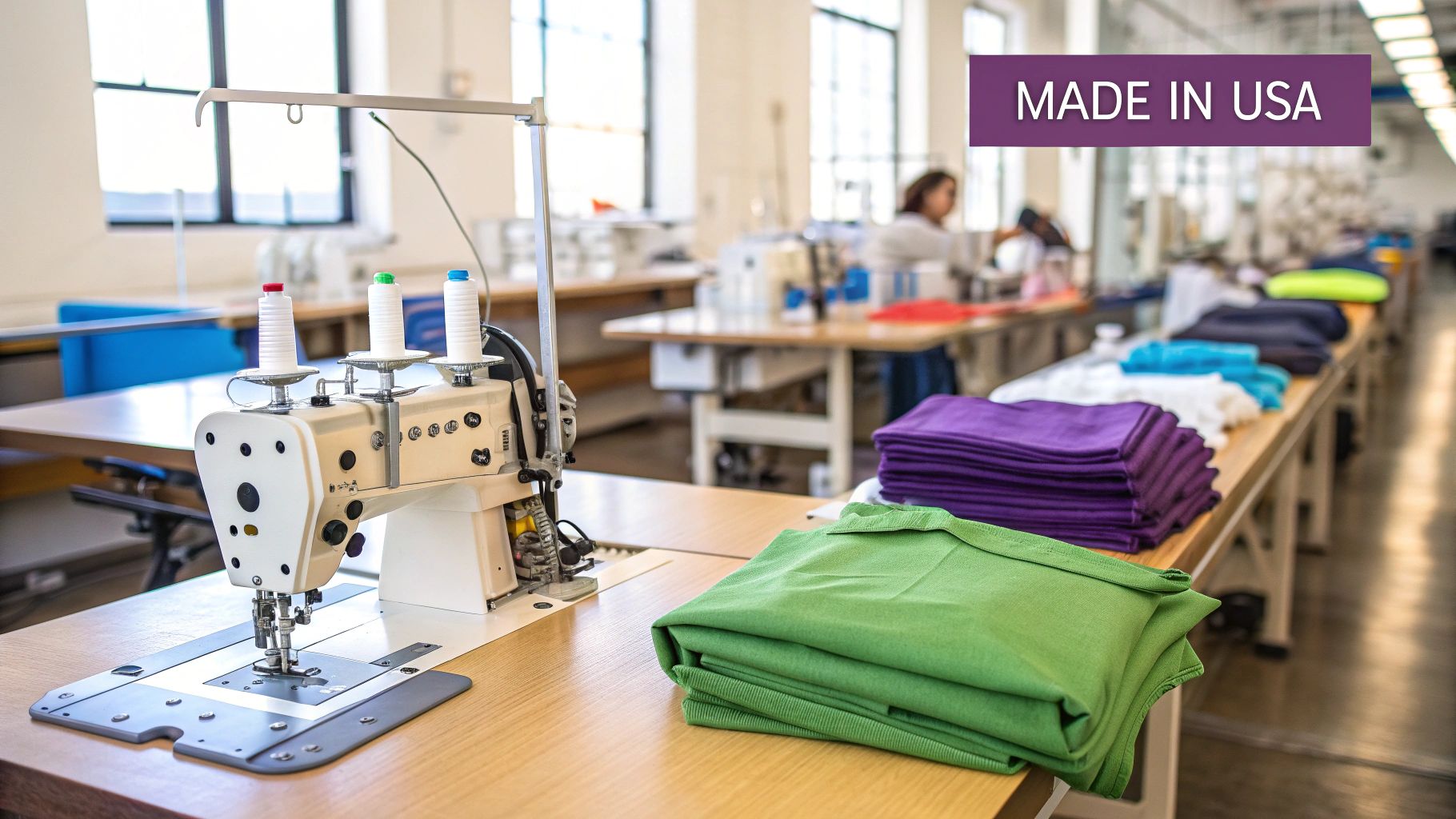
Making apparel here in the States isn’t just about patriotism anymore—it’s a smart business play. In a world defined by the blink-and-you’ll-miss-it speed of e-commerce, a growing demand for sustainable practices, and the rise of personalization, domestic manufacturing just makes sense. Brands are quickly learning that having their production partner close by makes them far more agile and resilient.
This isn’t happening in a vacuum. The U.S. apparel industry is on a solid growth track, projected to hit around $395 billion in 2025 with a steady annual growth of about 4.6%. A huge chunk of that—38% of sales—now happens online, which is fueling the fire for custom, quick-turn apparel. You can dig deeper into these apparel industry insights on MakersRow.com.
The Power of Proximity and Quality Control
When your manufacturer is a few states away instead of an ocean away, everything gets easier. Communication is clearer, and problems get solved in real-time. You can actually visit the facility, inspect the quality with your own eyes, and build a real partnership.
That level of hands-on control is nearly impossible with overseas production, where language barriers and massive time zone differences can turn a tiny hiccup into a major delay.
For a startup or a growing brand, the ability to physically touch a pre-production sample or quickly fix a stitching issue without waiting weeks for international shipping is a total game-changer. It compresses timelines and ensures the final product is exactly what you envisioned.
Working with US-based manufacturers also means they’re held to strict labor and environmental standards. This isn’t just about compliance; it reinforces your brand’s commitment to ethical production—a factor that shoppers care more about every single day.
Speed to Market in the E-commerce Era
In today’s fast-fashion, social-media-driven world, speed is everything. A trend can blow up and fizzle out in a single season. Domestic manufacturing slashes lead times by cutting out weeks of container shipping and customs headaches.
This agility allows your brand to:
- Launch new designs quickly to jump on emerging trends.
- Restock popular items faster, so you never lose sales to stockouts.
- Offer on-demand or small-batch production, reducing the risk of getting stuck with a warehouse full of unsold inventory.
Think about it: a streetwear brand can react to a viral meme by designing, producing, and shipping a limited-edition tee in a matter of weeks, not months. That’s a massive competitive advantage.
Building Brand Value with ‘Made in the USA’
That “Made in the USA” label is so much more than a tag. It’s a powerful marketing tool that instantly signals quality, ethical production, and support for the local economy. For a lot of consumers, it’s trusted shorthand for a product that’s built to last.
When you partner with US-based manufacturers, you’re not just making clothes; you’re crafting a brand story that resonates. You’re appealing to customers who value transparency and local craftsmanship, and that narrative can set you apart in a seriously crowded market. It turns a simple garment into a statement of quality and integrity.
To help you navigate this decision, we’ve put together a quick-reference table. Think of it as your cheat sheet for vetting potential partners.
Key Factors When Choosing a US Apparel Manufacturer
| Factor |
Why It Matters for Your Brand |
Questions to Ask |
| Minimum Order Quantity (MOQ) |
Directly impacts your initial investment and inventory risk. High MOQs can be a barrier for new brands or limited-edition runs. |
What is your MOQ per style and color? Are there lower minimums for re-orders? |
| Turnaround Times |
Determines how quickly you can get your product to market. Faster times mean more agility to respond to trends. |
What are your average lead times for production? Do you offer rush services? |
| Customization Methods |
The techniques they offer (e.g., screen printing, embroidery, cut and sew) define the creative limits of your designs. |
Which decoration methods do you specialize in? Can you provide samples of each? |
| Material Sourcing |
The quality and type of fabrics impact your final product’s feel, durability, and price point. Domestic sourcing adds to the “Made in USA” story. |
Where do you source your fabrics? Do you offer sustainable or organic options? |
| Design & Development Support |
Invaluable for brands that need help translating a concept into a production-ready design. |
Do you offer services like pattern making or tech pack creation? |
| Quality Control Process |
Ensures your final products meet your standards and reduces the rate of defects and returns. |
What is your QC process? Can I review samples before the full production run? |
| Communication & Partnership |
A good partner is responsive and collaborative. Poor communication can lead to costly mistakes and delays. |
Who will be my main point of contact? How often can I expect updates? |
Choosing a manufacturing partner is one of the most critical decisions you’ll make. Taking the time to ask these questions upfront will save you a world of headaches down the road and set your brand up for long-term success.
Defining Your Production Needs Before You Search
Before you even think about emailing a US-based custom apparel manufacturer, you need to do your homework. Seriously. Showing up with a half-baked idea is the fastest way to get ignored or, worse, get a quote that’s completely off the mark. Manufacturers are busy people, and they naturally prioritize brands that come prepared with a clear, professional vision.
This prep work isn’t just about looking like you know what you’re doing—it’s about saving yourself a massive amount of time, money, and future headaches. A well-defined plan helps you get accurate quotes, find the right partner faster, and avoid those costly “misunderstandings” that can derail a production run.
Think of it this way: you wouldn’t ask a contractor to build a house without a blueprint. The result would be a chaotic, expensive mess. The same logic applies here.
Build Your Professional Tech Pack
The single most important document you will create is your tech pack. A tech pack (short for technical packet) is the universal language of apparel manufacturing. It contains every single detail a factory needs to bring your design to life exactly as you see it in your head. A weak tech pack leads to mistakes. A strong one ensures precision.
Your tech pack needs to be a comprehensive guide, not just a quick sketch on a napkin. Here’s what it absolutely must include:
- Detailed Garment Specs: This means flat sketches (front, back, and side views) with precise measurements for every component, from the exact sleeve length to the width of the collar.
- Fabric and Material Information: Be specific. Don’t just write “cotton.” Specify something like “100% GOTS-certified organic ringspun cotton, 180 GSM.” Include info on trims like buttons, zippers, and drawstrings.
- Stitching and Seam Details: Call out the exact type of stitching you need, like a flatlock seam for activewear or a double-needle stitch on a t-shirt hem.
- Color Information: Provide Pantone (PMS) color codes for all fabrics, threads, and printed graphics. This is crucial for getting the colors perfect.
- Branding and Labeling Placement: Show exactly where you want your custom neck tags, hem tags, or other branded elements placed, including measurements from the seams.
This level of detail proves you’re serious and helps a potential partner instantly know if they have the right equipment and skills for your project.
Nailing Down The Business Details
Beyond the design, you need a firm grip on the business side of things. Manufacturers will ask you pointed questions about your budget and order size, and having clear answers is non-negotiable. This information tells them whether you’re a good fit for their operational scale.
For instance, a factory that specializes in high-volume orders for major retail brands probably isn’t the right partner for a startup launching with 50 t-shirts. Being upfront about your needs from the get-go ensures you connect with the right type of manufacturer.
A classic rookie mistake is getting lost in the creative vision while completely neglecting the financial framework. A manufacturer sees you as a business partner. They need to know you’ve done the math to make the whole thing viable.
Here are the key business metrics you need to have locked down:
- Target Cost Per Unit: Figure out the absolute maximum price you can pay per garment and still be profitable after you factor in marketing, shipping, and other overhead. Be realistic and research what similar items typically cost to produce.
- Initial Order Quantity (MOQ): Decide how many units you plan to order for your first run. Be honest. If you’re starting small, you need to find manufacturers who accommodate low MOQs.
- Future Scalability: Think ahead. Do you plan to reorder this design? Do you see your order sizes growing significantly in the next year? Sharing this helps a manufacturer understand your long-term potential as a client.
Choosing Your Customization Method
Finally, you need to decide how your apparel will be decorated. The method you choose directly impacts the cost, feel, and durability of the final product. Different manufacturers specialize in different techniques, so knowing what you want helps narrow your search significantly.
Here are the most common options to consider:
- Screen Printing: Best for larger runs with simple, bold graphics. It’s durable and very cost-effective at scale.
- Direct-to-Garment (DTG): Ideal for complex, multi-color designs or photographic prints, especially on smaller batches. It offers incredible detail, often with no minimums.
- Embroidery: Provides a premium, textured finish that’s perfect for logos on hats, polos, or jackets. It’s typically priced by the stitch count.
- Cut and Sew: This is the ultimate level of customization. Instead of just decorating a blank garment, the manufacturer creates the entire piece from raw fabric based on your unique pattern. This gives you total control over fit and style but comes with higher MOQs and costs.
Getting these three areas clarified—your tech pack, your business numbers, and your customization method—transforms you from a hopeful dreamer into a prepared professional. This groundwork is absolutely essential for having productive conversations with custom apparel manufacturers in the USA. If you’re building a brand from the ground up, especially with unique items like socks, taking the time to get a clear start on your design process can make all the difference.
Decoding Customization Methods And Technologies
Choosing how to put your design on a garment is just as critical as the design itself. The right technique brings your vision to life, but it also has a massive impact on your budget, turnaround time, and the final product’s quality and feel. For any brand working with custom apparel manufacturers in the USA, getting a handle on the core technologies is the first step to getting exactly what you want.
Each method tells a different story. One might scream durability and value for a big event, while another whispers exclusivity and detail for a limited-edition drop. This isn’t just a technical choice—it’s a brand decision.
Screen Printing: The Workhorse Of Bulk Orders
Screen printing is the tried-and-true classic for a reason. It involves pushing ink through a stenciled mesh screen directly onto the fabric, creating a bold, durable design that sits right on top of the garment. It’s incredibly cost-effective for larger orders because the main expense is in the initial screen setup.
Once the screen (or “stencil”) is made, you can use it over and over again. This means the cost per shirt plummets with every unit you produce. It’s the undisputed champion for:
- Event merchandise for concerts, 5Ks, or festivals.
- Company uniforms and staff apparel.
- Retail brands producing a high volume of the same design.
But here’s the catch: its reliance on a separate screen for each color makes it a poor choice for photographic images or designs with lots of gradients. If you need a simple, two-color logo on 500 tees, screen printing is unbeatable. For a complex, full-color painting on just 20 shirts? You’ll want to look elsewhere.
Direct-to-Garment (DTG): For Intricate, Full-Color Detail
Think of Direct-to-Garment (DTG) printing like a high-end inkjet printer, but for t-shirts. It applies eco-friendly, water-based inks directly onto the garment, allowing for an unlimited color palette and stunning, photorealistic detail. The ink soaks into the fibers, which gives it a much softer feel than screen printing.
This technology is a game-changer for small batches and highly detailed artwork. Since there are no screens to create, the setup cost is practically zero, making it perfect for print-on-demand services and limited-run collections. If your design has intricate shading, a ton of colors, or a photographic element, DTG is your best bet.
The rise of DTG is a huge reason the custom apparel market is booming. It empowers brands to test new designs without the financial risk of ordering hundreds of units upfront.
The custom apparel market is projected to hit $4.2 billion globally by 2032, with North America’s share expected to nearly double to $1.45 billion. This growth is fueled by innovations like DTG that make high-quality, personalized clothing accessible to everyone, shifting the industry from bulk-only to on-demand.
Sublimation And Embroidery: For Premium Finishes
Sometimes, you need a method that offers a different kind of impact. Sublimation and embroidery provide unique textures and appearances that standard printing just can’t match.
Sublimation is a wild process where heat turns solid ink into a gas that bonds directly with polyester fibers. The result is a vibrant, permanent, all-over print that you can’t even feel on the fabric—it literally becomes part of the shirt. It’s the magic behind custom athletic jerseys, performance wear, and eye-catching patterned leggings. The one major limitation? It only works its magic on light-colored, synthetic fabrics.
Embroidery involves stitching a design directly onto the garment with thread. It adds a premium, textured, and incredibly durable finish that screams quality and professionalism. It’s the top choice for logos on hats, polos, and jackets. The cost is based on the stitch count, so larger, more complex designs will naturally be more expensive. These same principles of detailed production can be applied to other items as well; you can learn more about how custom socks are made in our article.
This decision tree helps visualize how factors like your garment type, quantity, and budget point to the best customization method for your project.
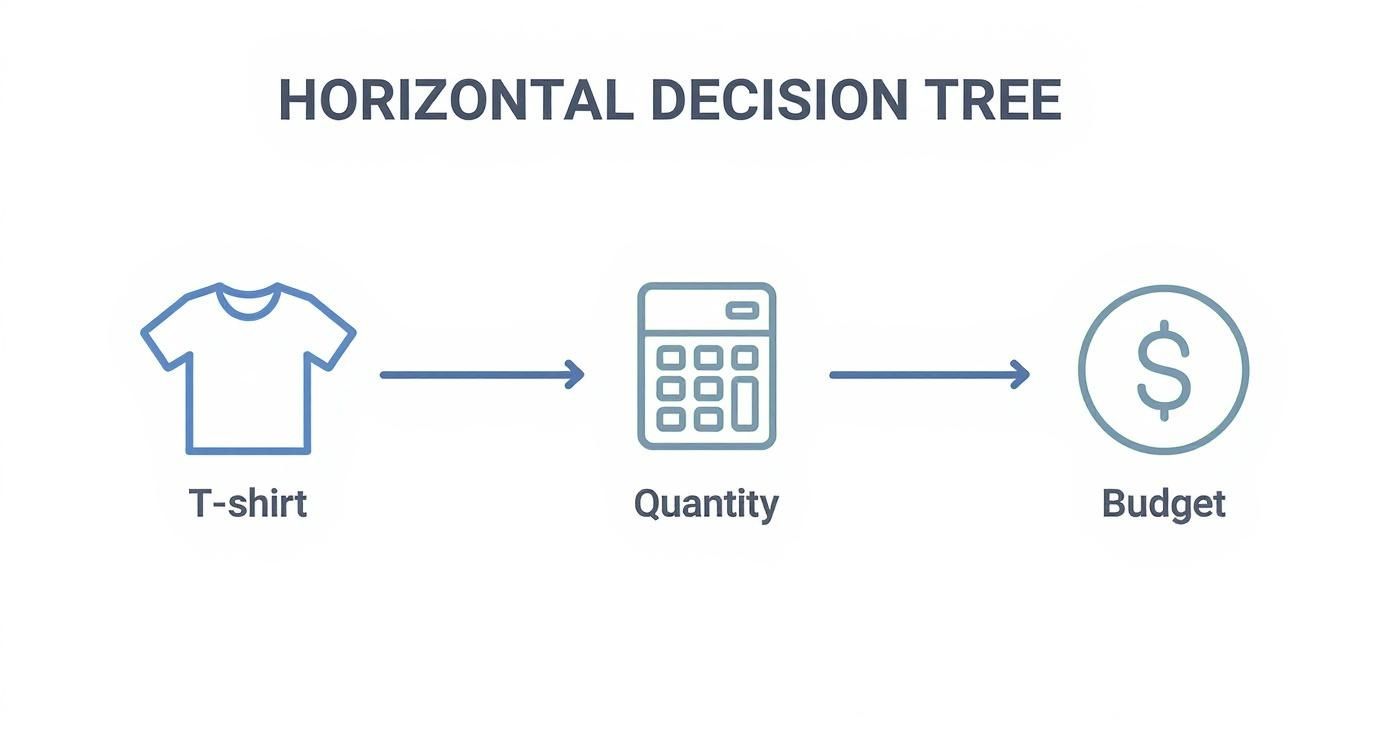
As you can see, high-volume orders with simple designs are a perfect match for screen printing, while DTG absolutely shines for detailed, low-quantity runs. Knowing the difference is key to guiding your brand toward the most efficient and effective production path.
How To Properly Vet Potential Manufacturers
 Finding a list of potential custom apparel manufacturers in the USA is the easy part. The real work starts when you have to sift through the slick sales pitches to find a true partner. Let’s be honest: proper vetting is the single most important thing you can do to build a solid supply chain and make sure your final product actually looks like your vision.
This goes way beyond just comparing price quotes. You need to get into the weeds of their process, see their quality for yourself, and—most importantly—figure out if they’re good people to work with. A great manufacturing partner solves problems with you; a bad one creates them.
Start By Getting Samples In Hand
Never, ever commit to a production run without physically touching a sample. A manufacturer’s website can look amazing, but the proof is in the stitching, the feel of the fabric, and the richness of the print.
And be specific about what you ask for. Don’t just request a generic “sample.” Ask for a garment similar to what you want to produce, using the exact customization method you plan to use. If you need embroidered hoodies, don’t let them send you a screen-printed t-shirt.
Once the sample arrives, it’s time to play detective. Here’s what I always look for:
- Stitching Quality: Are the seams straight and consistent? Any loose threads or puckering, especially around high-stress areas like collars and cuffs?
- Color Accuracy: Hold the garment up to your tech pack. How well did they match your Pantone codes? Is the color vibrant or washed out?
- Print or Embroidery Feel: Does the screen print feel thick and rubbery, like it’s just sitting on top of the fabric? Or is it soft and integrated? Is the embroidery clean and tight with no loose loops?
- Overall Construction: Does the thing just hang right? Are the labels sewn in straight? It’s these small details that scream quality (or a lack of it).
This tactile inspection is your first real piece of evidence. If the sample is sloppy, you can bet your full production run will be, too.
Ask The Tough Questions
With a sample in your hands, it’s time to dig into their operations. This is where you separate the seasoned pros from the operations that are just winging it. A good partner will have clear, confident answers, while a poor one will give you vague responses or get defensive.
Think of this as an interview for a critical team member, because that’s what they are. You need to understand their process, their ethics, and how they handle things when—not if—they go wrong.
A manufacturer’s true character isn’t revealed when things are going perfectly. It’s revealed when a shipment of fabric is delayed or a screen misaligns. You need a partner who communicates proactively and works toward a solution, not one who vanishes or points fingers.
The custom clothing market in North America is on fire, hitting an estimated $20.1 billion in 2024 and projected to grow at 8.0% annually through 2033. This boom is driven by brands demanding higher quality and more personalization. A manufacturer who can’t answer basic questions about their supply chain simply isn’t built to compete in this market. For more data, check out this report on the dynamic custom clothing market from cognitivemarketresearch.com.
Test Their Communication And Responsiveness
This might be the most critical part of the whole vetting process, yet it’s the one people overlook the most. Your manufacturer is a collaborator. If they take three days to answer a simple email now, just imagine the radio silence when there’s an urgent problem with your 500-unit order.
Pay close attention to how they communicate during these early stages.
- Responsiveness: How quickly do they reply to your emails and calls? Are we talking hours or days?
- Clarity: Are their answers direct, or do they talk in circles and use confusing jargon?
- Proactiveness: Do they anticipate your questions? Do they offer helpful suggestions you hadn’t thought of?
- Point of Contact: Are you getting a dedicated account manager, or are you being tossed into a generic customer service queue?
The human element is everything. You’re looking for a partner who feels invested in your success, not a factory that treats you like just another order number. This same principle applies across your supply chain; our guide on how to find wholesale suppliers for your business covers similar ground on the importance of reliability and communication.
By combining a physical quality check with a deep dive into their processes and a real-world test of their communication, you can find a partner you can actually trust. This tough vetting process is what ensures you don’t just get great apparel—you get a US-based manufacturer who will be a genuine asset to your brand’s growth.
Getting Real About MOQs, Turnaround Times, and Pricing
https://www.youtube.com/embed/Dzwu14Vlbsw
Once you’ve nailed down your designs and customization methods, the conversation with any potential custom apparel manufacturer in the USA will quickly pivot to the big three: Minimum Order Quantities (MOQs), turnaround times, and pricing. These aren’t just numbers on a spreadsheet; they’re the logistical realities that shape your initial investment, your launch timeline, and your brand’s profitability from day one.
Getting this part wrong can be a painful and expensive lesson. But when you understand how these three elements connect, you can easily spot the right partner for where your brand is right now. A factory’s numbers tell you a story about who they’re really set up to serve.
What’s the Deal with Minimum Order Quantities?
A Minimum Order Quantity, or MOQ, is simply the smallest order a manufacturer is willing to run for you. This isn’t some arbitrary rule meant to weed out startups; it’s a matter of pure operational efficiency. Firing up the machinery, mixing the perfect ink colors, and dedicating a team to your project has fixed costs. Manufacturers need to produce enough pieces to make the whole run worthwhile.
For a new brand, a high MOQ can feel like hitting a brick wall. The thought of ordering 500 units of a design you haven’t even tested in the market is enough to cause a cold sweat. It’s a massive financial gamble.
But here’s the good news: the American manufacturing scene is more diverse than ever. While the huge factories might need orders in the thousands, a growing number of smaller, more agile shops are built specifically for startups and emerging brands. These partners often have much more approachable minimums, sometimes as low as 50 or even 24 pieces per design.
When you’re talking MOQs, get specific. Don’t be afraid to ask:
- Is that minimum per style, per color, or for the total order?
- What do the price breaks look like if I order more?
- Are the minimums for reorders lower than the initial run?
Finding a manufacturer with a flexible MOQ is a game-changer. It lets you test new ideas, keep your inventory lean, and grow your brand without betting the farm on a single design.
Decoding Production Turnaround Times
Turnaround time is the clock that starts ticking the moment you approve your final sample and stops when your finished apparel is boxed up and ready to ship. This timeline can swing wildly from one shop to another, and it’s influenced by a lot of factors that aren’t always obvious.
A manufacturer might quote you “4-6 weeks,” but you need to dig into what that really means. Does that include the time it takes to source a special fabric you requested? Does it account for the three other big projects they have in the queue ahead of you?
One of the biggest mistakes I see brands make is treating a quoted turnaround time like a guarantee. It’s an estimate. Always, always build a buffer into your launch schedule for the unexpected—a fabric shipment gets delayed, a machine breaks down, you name it.
To get the most accurate timeline possible, give the manufacturer your complete tech pack right from the start. The more details they have, the better they can plan. It also helps to ask about their busy seasons. A factory that does a ton of athletic team wear will be slammed in late summer getting ready for the fall sports rush. If you can schedule your run during their slower months, you might just get your order done faster.
Breaking Down the Price Tag
Finally, let’s talk money. When you get a price quote, it’s tempting to just scan for the final cost-per-unit and call it a day. But an experienced brand owner knows to look closer and figure out what’s actually included in that number—and more importantly, what isn’t.
A good quote should break everything down for you. If it doesn’t, ask for an itemized list. This is the only way to truly compare different manufacturers and sniff out any hidden fees before they bite you.
Your quote should spell out things like:
- Garment Cost: The price for the blank shirt, hoodie, or hat itself.
- Customization Cost: The fee for the actual screen printing, embroidery, etc. This is often based on things like the number of colors in a design or the stitch count.
- Setup Fees: Any one-time charges for making screens, digitizing an embroidery file, or prepping the machines.
- Sample Costs: The price to produce that all-important pre-production sample for you to approve.
- Finishing Services: Extra costs for things like sewing in custom tags, folding, and poly-bagging each item.
Seriously, never assume anything is included. Are shipping costs rolled in, or will that be a separate bill? Do they charge for a round of minor design tweaks? Asking these questions upfront will save you from surprise invoices later and keep your budget on track. This kind of due diligence is essential, whether you’re making basic tees or something more specialized like custom socks.
Common Questions About US Apparel Manufacturing
Jumping into domestic production brings up a handful of make-or-break questions, especially if you’re new to the game. Getting clear answers upfront can save you a world of headaches (and money). Let’s walk through the questions we hear most often from brands looking for custom apparel manufacturers in the USA.
What Is a Realistic Budget for a First Run?
This is the big one, and the honest answer is: it depends. Your budget will swing wildly based on the garment’s complexity, the quality of your fabric, the customization method you choose, and of course, the manufacturer’s MOQ.
For something straightforward like a run of screen-printed t-shirts, a partner with a low MOQ might get you started in the $1,000-$3,000 range.
But if you’re dreaming bigger—think cut-and-sew hoodies or custom-dyed jackets—your initial investment will be much higher. MOQs for those projects typically land in the 100-300 unit range, so you should realistically plan for a budget of $5,000 to $15,000, maybe more. Always get a detailed quote and don’t forget to factor in the costs for samples and shipping.
How Can I Protect My Designs?
Your intellectual property is everything. Protecting it isn’t just smart; it’s a non-negotiable first step. Before you even think about sending over a detailed tech pack or proprietary design, have the potential manufacturer sign a Non-Disclosure Agreement (NDA). This is standard practice for any professional outfit and creates a legal safety net for your ideas.
For things like your brand name and logo, filing for a trademark with the USPTO adds another strong layer of protection. While getting a design patent for a single garment can be a complex process, the NDA is your essential starting point. It’s what keeps your unique concepts from being copied or shared without your permission.
An NDA is your first line of defense. It signals that you are a serious professional and sets a clear expectation of confidentiality from the very beginning of the relationship.
Can I Supply My Own Blank Garments?
The answer to this varies from one shop to the next. Some businesses are decorators only—they just handle the printing or embroidery—and are totally fine working with goods you supply. Just be aware, they probably won’t guarantee the final result on materials they’re not familiar with and will likely ask for a spoilage allowance (a few extra pieces just in case of production errors).
On the flip side, many full-service custom apparel manufacturers in the USA insist on sourcing the garments themselves. This isn’t them being difficult; it’s how they maintain strict quality control and ensure the blanks are compatible with their machines, inks, and processes. Make sure you ask about their policy on “customer-supplied goods” in your very first conversation. This is just one of many details to get straight; for a broader look, you can explore some of the most frequently asked questions about custom manufacturing to cover all your bases.
Cut and Sew Versus Blank Customization
Getting this distinction is crucial. When a manufacturer customizes a “blank,” they’re taking a pre-made garment from a wholesaler like Bella+Canvas or Gildan and simply adding your design through printing or embroidery. This route is much faster and more cost-effective for standard items like t-shirts, hoodies, and hats.
A “cut and sew” manufacturer, however, builds your product from the ground up. They start with rolls of raw fabric and create your garment from scratch based on your unique patterns. You get to control every single detail: the fit, the stitching, the fabric, the custom tags, everything. This gives you complete creative freedom but also means a more intensive process, higher MOQs, and a longer timeline from start to finish. You go with cut-and-sew when your vision is for a truly one-of-a-kind product that you just can’t find off the shelf.
Ready to create something truly unique without the hassle of high minimums? The team at Custom Sock Shop designs and manufactures high-quality custom socks right here in the USA, with minimums as low as 12 pairs. Get a free digital mockup and see your vision come to life. Check out our process at https://customsockshop.com.