Athletic Socks
Print Socks
- Low Minimums
- Lowest Industry Pricing
- Free Shipping $250+
- USA Sock Designers

Ever wonder how a perfect pair of socks gets made? The secret lies in a fascinating piece of engineering called a circular sock machine. It’s the powerhouse technology that knits seamless socks in a continuous tube, allowing us to weave intricate designs directly into the fabric—designs that will never fade or peel.
This is where spools of thread are turned into wearable art with incredible speed.
Picture a circular sock machine as a high-speed carousel of needles all working in perfect harmony. Unlike old-school flat-bed knitting, which creates pieces that have to be sewn together, this process knits a sock from the cuff all the way down to the toe without a single uncomfortable seam.
This seamless construction isn’t just about comfort; it’s a hallmark of quality. It guarantees a perfect fit that moves with you, preventing the blisters and irritation that bulky seams can cause.
This guide will walk you through exactly how these machines operate, their surprisingly long history, and why knowing a little bit about them is the key to choosing high-quality custom socks. At its core, the machine is an automated system that builds a sock stitch by stitch, row by row, in a continuous spiral.
The entire journey from a simple cone of yarn to a fully formed sock happens right on this one device. This all-in-one process is what makes the technology so incredibly efficient.
The main benefits really boil down to a few key things:
The real magic of the circular sock machine is its ability to combine structure, design, and comfort into a single, automated process. It’s not just making a tube of fabric; it’s engineering a garment for a perfect fit right off the needles.
Understanding this technology gives you a real appreciation for what makes a great custom sock. For a deeper dive, you can learn more about how custom socks are made in our detailed guide. It’s a fascinating blend of old-school ingenuity and modern precision that goes into every pair you wear.
So, how does a simple thread become a fully-formed sock? Let’s pull back the curtain. At its core, a circular sock machine is like a high-speed, automated knitting carousel. Picture a central, rotating cylinder lined with dozens—or even hundreds—of tiny needles, all ready to jump into action.
As this cylinder spins, each needle performs a precise, lightning-fast dance. It grabs a thread, pulls it through a loop that was just made, and casts it off to create a brand-new stitch. This happens in a continuous spiral, building the tube of the sock row by row with incredible speed and consistency.
This diagram breaks down the journey from a single thread to a finished sock.
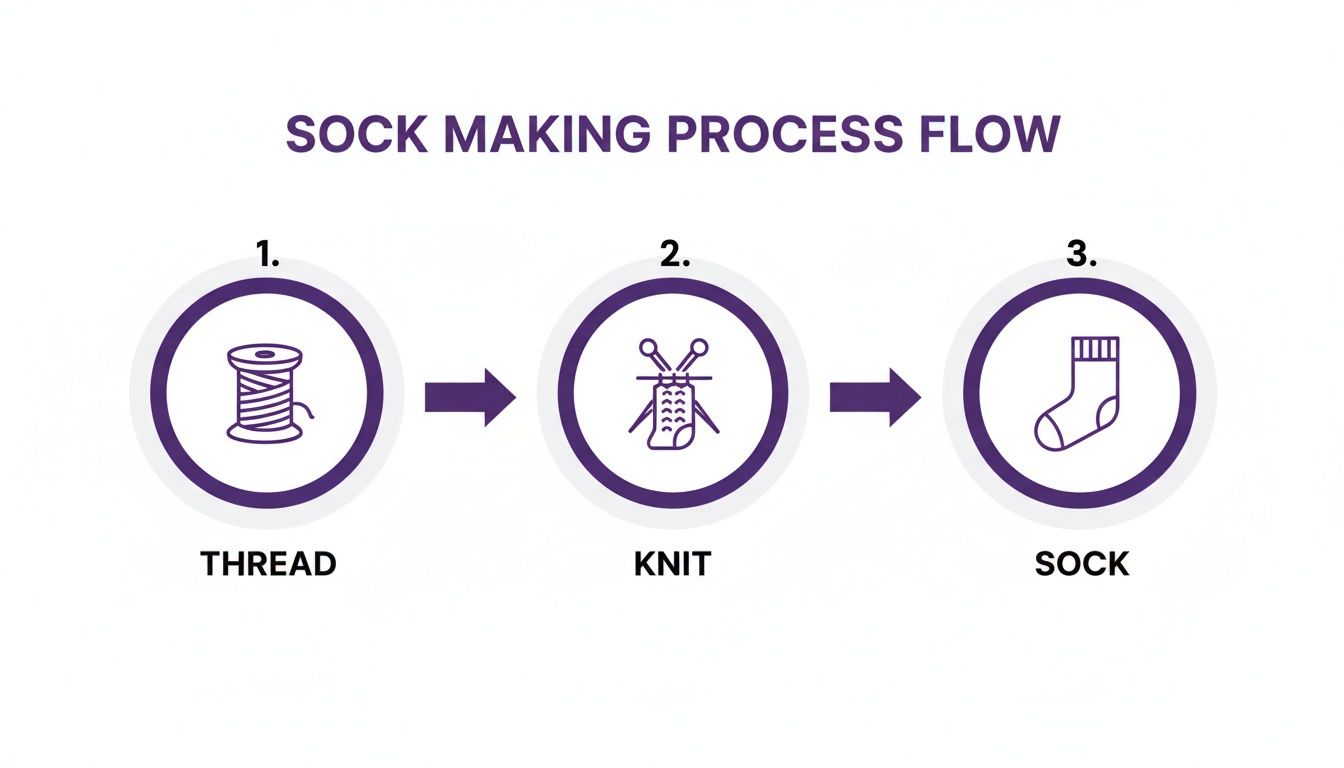
You can see how the raw yarn is fed directly into the knitting process, which then produces the final garment. It highlights just how efficient and self-contained these machines really are.
Several critical parts have to work together perfectly to bring a sock to life. This isn’t just random knitting; it’s a synchronized effort where each component has a specific job to ensure every sock comes out looking sharp.
Think of it like a perfectly choreographed assembly line. The cylinder spins the project, the needles build the product, and the sinkers provide quality control at every single step. This teamwork is what makes seamless knitting possible.
Now for the really cool part. One of the most impressive things about a modern circular sock machine is its ability to create complex, multi-color designs directly into the sock. The pattern isn’t printed on later; it’s woven right into the fabric as the sock is being made.
To pull this off, the machine uses multiple yarn feeders, each loaded with a different color thread. A computer program, fed by a digital design file, tells the machine exactly which feeder to use, for which needles, and at what time. As the cylinder rotates, the machine selects the correct colored thread at the perfect moment to build out logos, text, and intricate patterns.
This is what makes the difference between a cheap, printed sock and a premium custom one. Because the design is part of the sock’s actual structure, it will never crack, peel, or fade, no matter how many times you wash it. You can see how a digital concept translates to the final product when designing your own socks. The machine just methodically builds the image, one stitch at a time, creating a truly integrated and durable design.
While today’s sock machines feel like they’re straight out of a high-tech factory, their story actually started centuries ago. The concept isn’t new; it’s the result of a long, rich history of tinkering and refinement that completely changed how the world gets dressed.
Early versions were clunky, hand-cranked devices, but even then, they were a massive leap forward.
This technology really proved its worth during times of global conflict. The circular sock machine became a homefront hero during World War I and II, proving its immense value when speed and reliability were everything.
Governments worldwide loaned out over 100,000 units to women volunteers to meet the staggering demand from the military. By 1917 alone, U.S. records show the need for more than 20 million pairs of socks annually. You can get more details on this incredible wartime effort and the revolution of sock manufacturing on kvmanufacturing.com.
These manual machines slashed production time from hours by hand to under 30 minutes per pair—a monumental gain that kept soldiers’ feet dry and protected in awful conditions. This legacy of performance is the foundation that modern sock manufacturing is built on.
The jump from those early mechanical workhorses to the computerized powerhouses we use today was gradual, but it changed everything. Early innovators laid the groundwork, but it was the introduction of electronic controls that unlocked a whole new level of precision and creative freedom.
Key advancements that got us here include:
This evolution turned the circular sock machine from a tool of mass production into an instrument of mass customization. The core idea is the same, but the capabilities have expanded beyond what early inventors could have ever dreamed of.
The core benefits that mattered so much during the war—speed, reliability, and consistency—are the same qualities that make the modern circular sock machine essential today. What once took a dedicated volunteer half an hour to crank out by hand now takes just a few minutes for a fully automated machine to complete, with flawless precision every single time.
This history of innovation is exactly why we can offer intricate custom designs with such quick turnarounds. The technology has evolved, but its fundamental purpose hasn’t: to create a high-quality, seamless garment with incredible efficiency. From the trenches of Europe to the athletic fields and boardrooms of today, this machine continues to be an unsung hero of the textile world.
Not all circular sock machines are the same. Just like cars, they range from charming vintage models you might find in a museum to high-performance modern powerhouses that can knit a sock in minutes. The specific machine we use directly shapes the final sock’s style, level of detail, and even its texture.
Figuring out these differences is the key to appreciating what goes into a truly custom, high-quality sock.
The most obvious split is between the old-school hand-crank machines and the high-speed electronic models we use today. Hobbyists and historical buffs love the hand-cranked circular sock machines for their tactile, hands-on process. But for modern manufacturing, it’s all about computer-controlled electronic machines that deliver incredible speed, precision, and design complexity, turning a digital file into a finished sock in a flash.
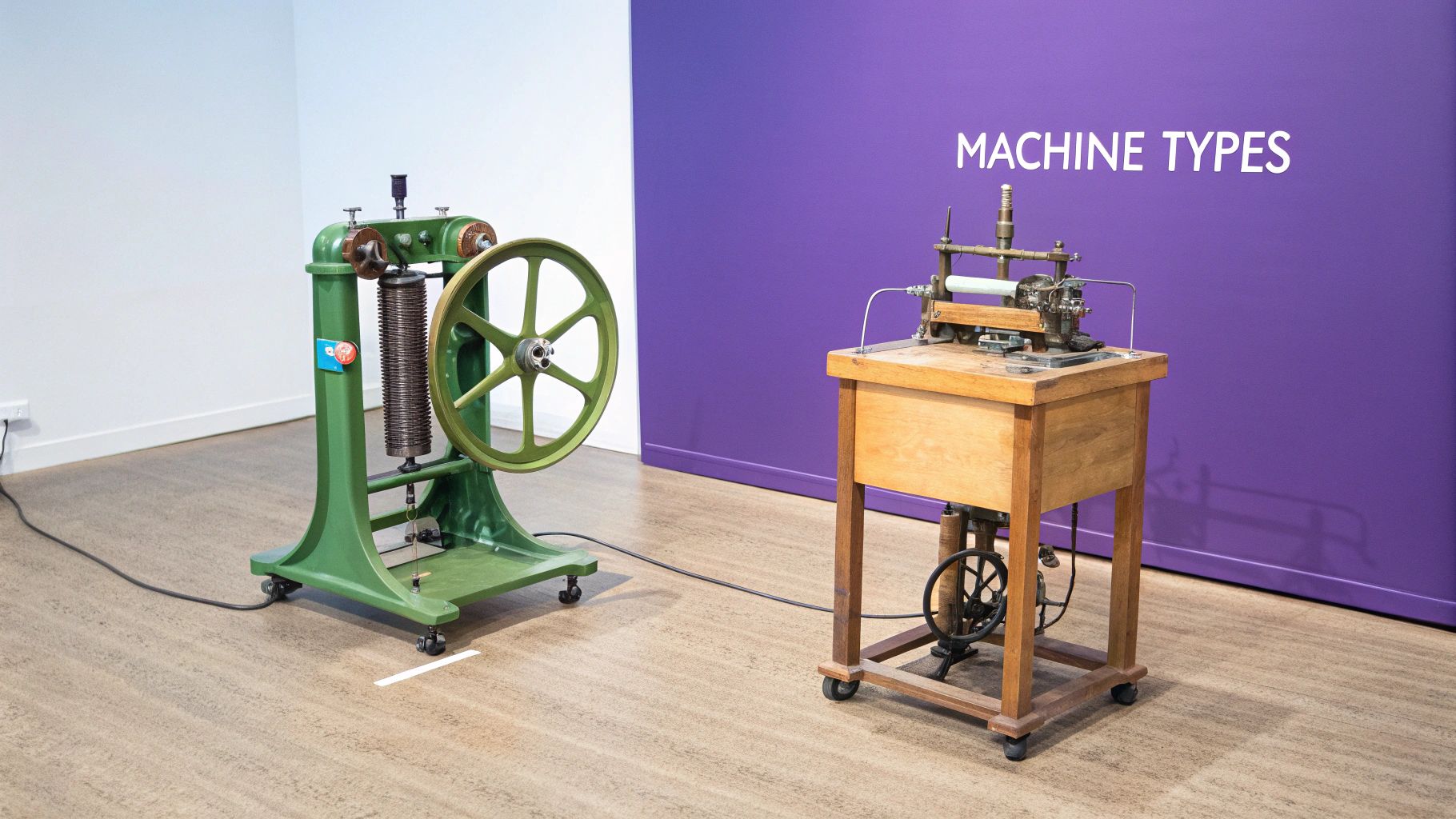
Beyond how they’re controlled, the cylinder setup is what really separates the machines. There are two main types—single-cylinder and double-cylinder—and each is built to excel at making different kinds of socks.
The vast majority of custom socks, especially those for teams, events, and corporate branding, are made on single-cylinder machines. Their knack for handling complex graphics and creating cushioned athletic styles makes them the go-to choice for vibrant, functional designs.
The last piece of the puzzle is the needle count, also known as the gauge. Think of needle count like the resolution on your TV screen—the more needles a machine has, the higher the “resolution” of the knit. A higher needle count means the stitches are smaller and packed closer together, allowing for much finer details and sharper images in woven-in designs.
This spec is what really determines a sock’s final texture and purpose:
To help you see how these factors come together, here’s a quick breakdown of the different machine types.
| Machine Type | Control | Best For | Production Speed | Design Complexity |
|---|---|---|---|---|
| Antique Hand-Crank | Manual | Hobbyists, historical demos | Very Slow | Low to Moderate |
| Single-Cylinder | Electronic | Athletic, casual, custom logo socks | High | High (excellent for graphics) |
| Double-Cylinder | Electronic | Ribbed dress socks, formalwear | Moderate | Moderate (specialized for ribbing) |
| High Needle Count | Electronic | Fine-gauge dress socks, detailed patterns | Moderate to High | Very High (photographic detail) |
Choosing the right machine and needle count all comes down to what the sock is for. Of course, the yarn plays a huge role, too. You can check out our guide on choosing the right material for your custom socks to see how yarn choice and machine capabilities go hand-in-hand. Here at Custom Sock Shop, we use state-of-the-art machines that hit that perfect blend of detail and durability needed for truly standout custom designs.
You might think of a circular sock machine as something for a niche hobbyist, but in reality, it’s the powerhouse behind a massive global industry. From high-performance athletic gear to high fashion and corporate branding, these machines are at the heart of a market that’s absolutely exploding. This isn’t just about cranking out socks anymore; it’s about mass customization.
And the scale of this growth is staggering. In 2024, the global market for circular sock machines was valued at a cool $13,750 million. By 2032, it’s projected to nearly double, hitting $26,500 million. That boom is driven by a steady 6.8% compound annual growth rate, a number that leaves the general textiles sector in the dust. While China might lead in sheer volume, North America holds a commanding 15-20% of the market, thanks to innovators like us who prioritize premium, customizable production. You can dig deeper into these market trends and projections on futuremarketreport.com.
At the center of this industry-wide boom are the fully automatic, electronic machines. These modern workhorses are the undisputed champions, making up 57% of the market share and completely changing the game for sock production.
Unlike the manual machines of the past, these are controlled by sophisticated software that delivers unbelievable speed and precision. They can seamlessly weave complex, multi-color designs directly into the sock, turning a digital file into a pattern that’s sharp, vibrant, and built to last. This is the technology that makes everything from detailed company logos to photo-realistic graphics possible.
Today’s circular sock machine is a fusion of mechanical engineering and digital artistry. It allows manufacturers to produce socks at speeds of up to 1,000 pairs per hour while offering a level of design complexity that was once unimaginable.
So, why does any of this industrial talk matter to you? Because it highlights a massive advantage. When a company owns and operates its own fleet of advanced circular sock machines—like we do—it means they have direct, hands-on control over the entire manufacturing process. That in-house capability is a game-changer.
Here’s why that makes a real difference for your order:
That control translates directly into a better product and a smoother, faster experience for you. It’s the difference between working with a broker and partnering directly with the experts who bring your vision to life, one stitch at a time.
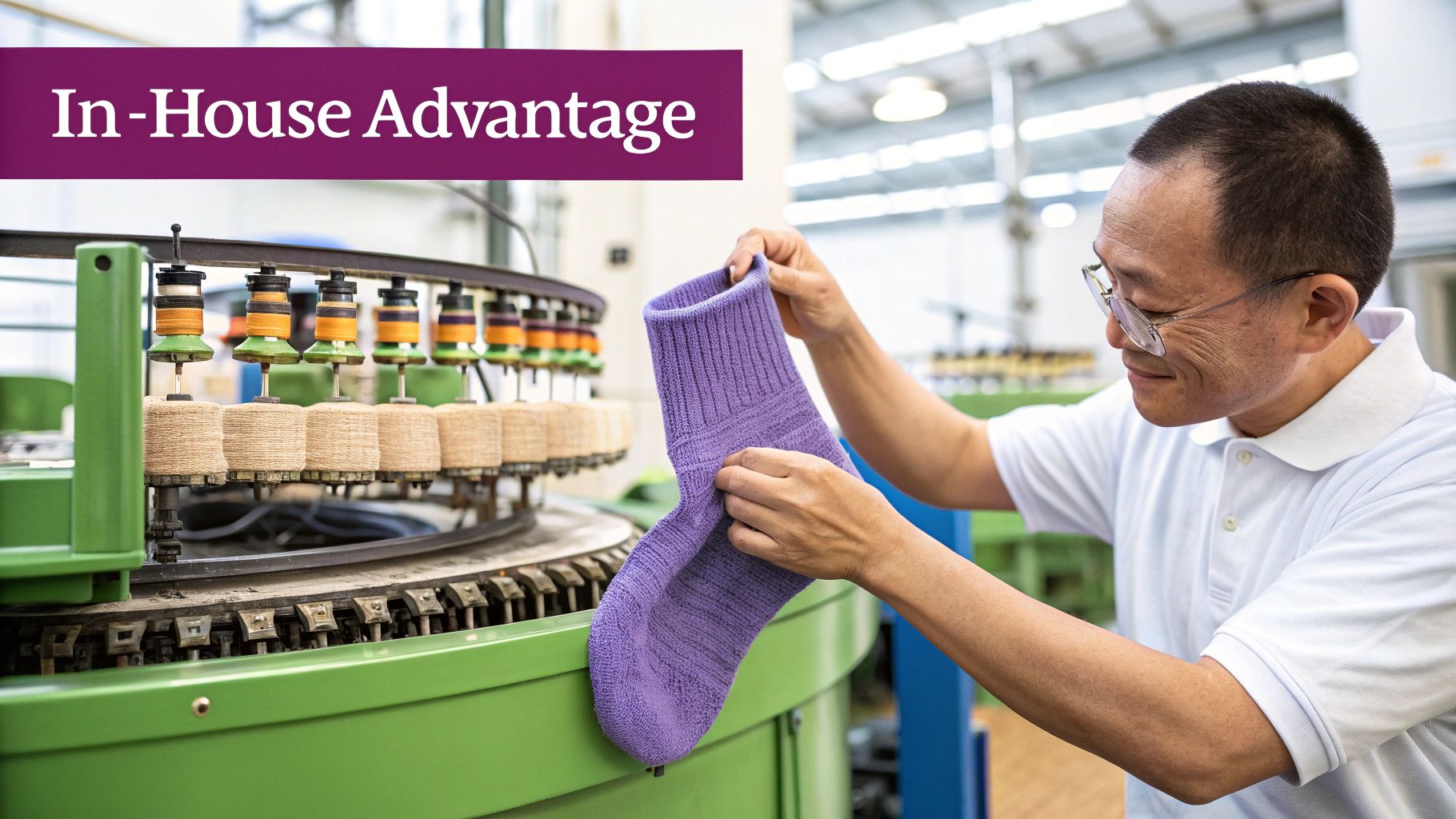
Understanding the tech behind a circular sock machine is one thing. Knowing who’s actually running it is something else entirely. Here’s a little industry secret: many companies in the custom apparel world don’t actually make their own products.
They’re middlemen. They outsource production, often overseas, creating a tangled web of communication gaps, unexpected delays, and quality that seems to change with the wind. When you work with a middleman, you’re always one step removed from the people physically knitting your socks, which can turn a simple design tweak into a week-long headache of back-and-forth emails.
But when you partner with a manufacturer that has its own machines right here on site, everything changes. Owning and operating our own fleet of circular sock machines gives us direct control over every single stitch.
Controlling production isn’t just about having the equipment—it’s about owning the outcome. It means the team that helps you finalize your design is the same team that programs the machines and inspects your socks the second they come off the line.
This unified approach gives us a massive edge, and it gives you a better product.
When you communicate directly with the experts operating the machinery, the entire process becomes smoother and more reliable. You’re not just another order number; you’re a partner in creation, ensuring the final product is exactly what you envisioned.
This hands-on approach is at the core of everything we do. You can see for yourself by exploring our in-house process to understand how direct oversight allows us to turn great ideas into even better socks—faster and more reliably than anyone else.
It’s the difference between hoping for quality and guaranteeing it.
We get asked a lot about the technology humming away in our shop. And while a circular sock machine is a marvel of modern engineering, it’s not magic—just a really, really smart piece of equipment. Here are the answers to a few of the most common questions that come our way.
Think about this: the old hand-cranked models from back in the day could take a good 30 minutes to churn out a single sock. Today’s computer-controlled machines? They’re in a completely different league.
Depending on how complex the design is, a modern circular sock machine can knit a complete, high-quality sock in just a few minutes. That incredible speed is exactly what allows us to offer such fast turnarounds on custom orders for teams, companies, and big events.
The efficiency is staggering. A modern circular sock machine takes what used to be a long, manual process and condenses it into a few automated minutes. This lets us deliver mass customization without ever cutting corners on quality, which means our clients get their socks faster.
Pretty much, but there are some practical limits to keep in mind. Because woven designs are literally knitted into the fabric with different colored threads, things like super-fine text or photorealistic gradients can be tricky to get just right.
For most logos, patterns, and mascots, though? These machines produce a beautiful, durable result where the design is part of the sock itself—not just sitting on top of it.
This is a big one. A woven sock has the design knitted directly into the fabric as it’s being made. This process creates a design that’s incredibly durable and gives the sock a classic, premium feel. It’s built to last because it’s part of the sock’s structure.
A printed sock, on the other hand, starts as a blank canvas. The design is applied to the surface later using methods like dye-sublimation. It’s a totally different approach, and in our experience, nothing beats the quality and longevity of a woven-in design.
Ready to see what our machines can do for you? Custom Sock Shop makes creating high-quality, American-made custom socks fast and easy. Start your design today!